APPLICATION NOTE

AC18.10665 – Black Mass, Recycled Li-NMC Batteries

SUMMARY

This application note describes the digestion of AC18.10665, a Recycled Li-NMC Battery (Black Mass) Certified Reference Material, using two distinct digestion methods and ColdBlock™ Digestion Pro Series technology.
Instrument: ColdBlock CBM sample digester, chiller, ICP-OES
Published: June 2026
Digestion Time: 20-minute leach or 45-minute nitrating method
Acid Used: HNO3 + HCl or HCl, H2SO4 & HNO3
Average ColdBlock Recovery vs. CRM:
Leach Method
  • 101% Cobalt
  • 97% Lithium
  • 102% Nickel
  • 105% Phosphorus
Nitrating Method
  • 100% Aluminum
  • 104% Cobalt
  • 101% Lithium
  • 101% Nickel

Boost Your Lab's Speed and Efficiency with ColdBlock

METHODOLOGY

Leach Method

  1. The chiller temperature was set to -5 °C.
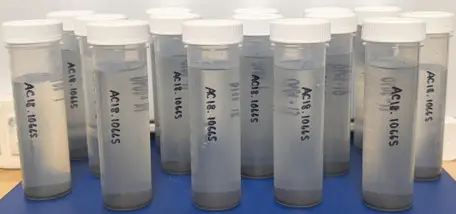
  2. Approximately 0.25 g of each sample was accurately weighed and transferred into a ColdBlock digestion vessel. Fifteen samples were prepared in total.
  3. 15mL of HNO3 was added to each vessel first, followed by 5mL HCl.
  4. Samples were digested at 60 % power for 20 minutes.
  5. Digestates were allowed to cool, then quantitatively transferred and diluted to a final volume of 50mL using a solution of 2 % HNO3 v/v.
Figure 1 – Leach method digestates

METHODOLOGY

Nitrating Method
  1. The chiller temperature was set to -5 °C.
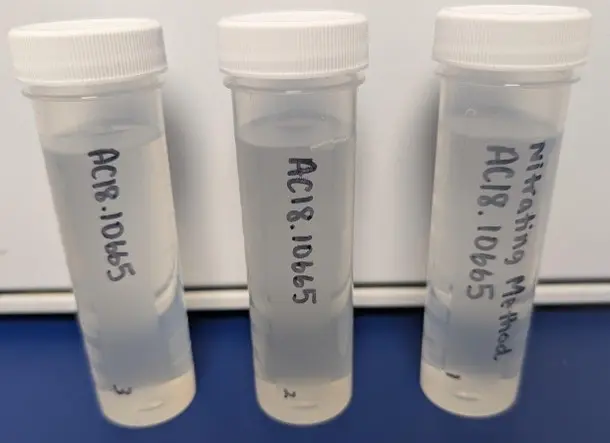
  2. Approximately 0.25 g of each sample was accurately weighed and transferred into a ColdBlock digestion vessel. Three samples were prepared in total.
  3. 5 mL of HCl was added to each vessel.
  4. Samples were digested at 60% power for 10 minutes.
  5. 10mL H2SO4 was added to each vessel slowly, and digest at 100% for 15 minutes.
  6. 10mL of H2SO4 was added dropwise to each vessel. Caution: this addition produces a highly exothermic reaction — reagent must be added slowly and carefully. Samples were then digested at 100% power for 15 minutes.
  7. Repeat step 5. Caution: this addition produces a highly exothermic reaction — reagent must be added slowly and carefully
  8. While digestates are still hot, quench the reaction dropwise with DI water.
  9. Digestates were allowed to cool, then quantitatively transferred and diluted to a final volume of 50 mL using DI water.
Figure 2 – Nitrating method digestates

DISCUSSION

  • The acid leach method, while suitable for a broad range of elements, demonstrated consistently low recoveries for aluminum (Al), calcium (Ca), magnesium (Mg), and titanium (Ti). These results are characteristic of leach-based digestions, which are not designed to fully decompose silicate mineral matrices or refractory phases, elements bound within these structures are largely left undigested
  • A key advantage of the acid leach method is the ability to scale sample sizes up to approximately 20 g, which is particularly beneficial when analyzing black mass samples, which can be inherently heterogeneous in nature.
  • The H₂SO₄/HNO₃ nitrating digestion method achieved excellent recoveries across all elements measured. The aggressive, oxidizing nature of the nitrating mixture combined with the elevated temperatures of the ColdBlock system promotes thorough matrix decomposition, liberating analytes that would otherwise remain undissolved under milder leach conditions.
  • While the nitrating method delivers superior elemental recoveries, it requires careful handling and should only be performed by trained personnel. The sequential addition of H₂SO₄ and the 1:1 H₂SO₄: HNO₃ nitrating mixture must be performed dropwise into hot digestates, as these additions produce highly exothermic reactions. Appropriate personal protective equipment (PPE) and fume hood operation are essential throughout the procedure.

Results

Table 1 – Leach Method Results

AC18.10665 – Black Mass Recycled Li-NMC Batteries (type 622)
Element Certified Values ColdBlock Average
n=15
St Dev  RSD ColdBlock Recovery
Co (wt.%) 2.97 3.01 0.047 1.6% 101%
Cu (wt.%) 0.564 0.55 0.007 1.3% 97%
Fe ((wt.%) 0.874 0.817 0.012 1.4% 94%
Li (wt.%) 1.81 1.75 0.025 1.5% 97%
Mn (wt.%) 2.84 2.85 0.037 1.3% 100%
Ni (wt.%) 9.19 9.34 0.102 1.1% 102%
P (wt.%) 0.145 0.152 0.005 3.6% 105%
S (wt.%) 0.552 0.555 0.007 1.3% 101%
Zn (ppm) 759 783 14.6 1.9% 104%
Zr (wt.%) 0.114 0.122 0.002 1.2% 107%
Al (wt.%) 4.57 2.42 0.039 1.6% 53%
Ca (wt.%) 0.242 0.18 0.008 4.5% 75%
Mg (wt.%) 0.107 0.08 0.001 1.3% 75%
Ti (wt.%) 0.028 0.014 0.0003 2.3% 51%

Table 2 – Nitrating Method

AC18.10665 – Black Mass Recycled Li-NMC Batteries (type 622)
Element Certified Values ColdBlock Average
n=3
St Dev  RSD     ColdBlock Recovery
Al (wt.%) 4.57 4.58 0.095 2.1% 100%
Ca (wt.%) 0.242 0.237 0.005 2.1% 98%
Co (wt.%) 2.97 3.08 0.022 0.7% 104%
Cu (wt.%) 0.564 0.558 0.006 1.0% 99%
Fe ((wt.%) 0.874 0.845 0.021 2.5% 97%
Li (wt.%) 1.81 1.83 0.01 0.5% 101%
Mg (wt.%) 0.107 0.097 0.001 1.5% 94%
Mn (wt.%) 2.84 2.81 0.036 1.3% 99%
Ni (wt.%) 9.19 9.25 0.079 0.8% 101%
Ti (wt.%) 0.028 0.026 0.0005 2.0% 92%
Zn (ppm) 759 763 7.09 0.9% 101%
Zr (wt.%) 0.114 0.113 0.002 2.0% 99%
Analytichem. Black Mass Recycled Li-NMC Batteries Certified Reference Material. Product No. AC18.10665.0100. Analytichem International; [April 2026].

Click here to download the Application Note in PDF format.

Join our monthly e-newsletter for expert tips, updates, and exclusive content delivered straight to your inbox.

ColdBlock Technologies Inc.
4551 Zimmerman Ave
Niagara Falls, ON L2E 3M5
info@coldblock.ca